Introduction
The book of Revelation in the Bible brings a mix of wonder and excitement as well as confusion in many church congregations these days. Revelation is filled with symbolism and prophecy, and many struggle to grasp the meaning. There is an endless sea of books, sermons, videos, etc. describing how these symbols can and/or should be interpreted by a vast array of teachers from varied theological backgrounds. Most of these interpretations only seem to add to the confusion in recent years. There is very little consensus in contemporary Christianity as to how the symbols and timelines should be definitively interpreted. A good majority of pastors will tell you they don't enjoy teaching Revelation. Some say they do not feel equipped to handle its subjects, though many congregations wish their pastors would teach it more frequently.
The opening letters to the churches in the book of Revelation are, however, not a mystery. These letters to the churches express the clear, authoritative, and distinct commands of Christ. These commands are, however, rarely heard or taught in many pulpits in this church age. One can only assume the reason for this to be that these messages and their content are not popular to a worldly church. They don't seem to fit with the picture of Christ that much of contemporary Christianity has seemed to have fashioned. These letters to the churches are the focus of this group of articles.
Understanding The Context Of Revelation
First things first. The Revelation of Christ given to John is just that - a revealing of the One and Only Risen Lord. This is the same Jesus of Nazareth who walked the earth, taught the nations, was crucified as the sacrifice for sins, and was raised from the dead. He demonstrated victory over sin, death, and the corruption of the fallen world. He also ascended to Heaven to rule and sits at the right hand of the Father while all of His enemies become subjected to Him as Head of the church, King of kings, and Lord of lords. (Acts 2:32-33, Acts 5:30-32, Hebrews 10:12-13).
John records seeing the Risen Christ:
I was in the Spirit on the Lord’s day, and I heard behind me a loud voice like a trumpet saying, “Write what you see in a book and send it to the seven churches, to Ephesus and to Smyrna and to Pergamum and to Thyatira and to Sardis and to Philadelphia and to Laodicea.”
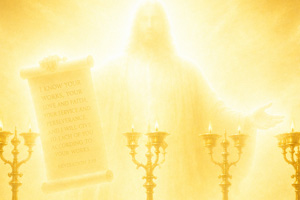
Then I turned to see the voice that was speaking to me, and on turning I saw seven golden lampstands, and in the midst of the lampstands one like a son of man, clothed with a long robe and with a golden sash around his chest. The hairs of his head were white, like white wool, like snow. His eyes were like a flame of fire, his feet were like burnished bronze, refined in a furnace, and his voice was like the roar of many waters. In his right hand he held seven stars, from his mouth came a sharp two-edged sword, and his face was like the sun shining in full strength.
When I saw him, I fell at his feet as though dead. But he laid his right hand on me, saying, “Fear not, I am the first and the last, and the living one. I died, and behold I am alive forevermore, and I have the keys of Death and Hades. Write therefore the things that you have seen, those that are and those that are to take place after this. As for the mystery of the seven stars that you saw in my right hand, and the seven golden lampstands, the seven stars are the angels of the seven churches, and the seven lampstands are the seven churches.
Veiled Or Revealed?
When John hears a voice like thunder and turns to see the voice speaking to him, he falls at His feet like a dead man (Revelation 1:17). This revelation of Christ compels an immediate, involuntary surrender and submission from John.
Still, this is the Jesus who walked with, ate with, rested with, and discipled John. John once laid his head on His chest at the Last Supper. This is the Jesus who (as a servant) washed John's dirty feet. John watched as Jesus was rejected, mocked, persecuted, ridiculed, beaten, spit on, stripped nearly naked, flogged, and crucified.
The Veiled Testimony
The testimony of Jesus recorded by inspiration of the Holy Spirit in the gospels (Matthew, Mark, Luke, and John) was and is a veiled testimony for many. Many saw Jesus only in His humanity. In the veil of unbelief, they humanized or minimized His teachings. They saw His works and His ministry as less than what they were, and failed to give Him the glory that belongs to Him.
For many of the masses recorded in the gospels, Jesus was a miracle worker whose abilities could not be denied. He was a healer who healed nearly everyone He came into contact with. He could make food appear out of thin air and fed multitudes in this way. In the midst of all this, only a few acknowledged His identity as more than a good teacher, a unique prophet, or a powerful fanatic. In spite of His miraculous abilities and teachings, His true identity was veiled to them as a result of their unbelief (Matthew 13:13-15, John 12:37-43, John 14:8-11, John 14:17, 2 Corinthians 4:3-4).
From the perspective of the scribes and pharisees recorded in the gospels, Jesus was a sinner, a false prophet and a deceiver who had come to destroy their traditional faith and contradict their teachings. (Luke 6:2, Luke 7:39, John 7:20, John 8:48, John 10:20) They accused Him of exercising His miraculous power as a manifestation of the work of the devil (Matthew 9:34, Matthew 12:24). He was a threat to their understanding of what it means to know God, so they sought to kill Him (John 5:18, John 9:29, John 10:19-39). They considered themselves faithful stewards and the only authorities of the truth from God. Jesus' true identity was veiled to them as a result of their unbelief.
From the perspective of the false prophets and false teachers recorded in the New Testament (who infiltrated the church after His resurrection and still do today), the life and teachings of Jesus are a means to an end (2Peter 2, Jude 4-13). By mimicking, counterfeiting, or twisting His teachings and authority, their goal is personal enlightenment, earthly success and blessing, personal moral superiority, or exclusive self-imposed spiritual wisdom and understanding (2 Peter 3:16, Romans 16:17-18, 2 Timothy 4:3-4). By their confident assertions that oppose the truth from Christ, they perpetuate deception and lead many astray (1 Timothy 1:6-7, Acts 20:28-30). Christ is veiled and hidden from them (as well as those who listen to them and follow their deception) due to unbelief.
Christ Unveiled
For a time, the Lord took on the form of a servant and came in the likeness of a man (Philippians 2:6-7), but this was only a temporary ministry. Like the veil in the temple separated men from the Holy of Holies, so did the body of Christ (in His earthly ministry) keep many from seeing the fullness of His glory. As the veil of the temple was torn in two when Christ gave Himself as the sacrifice for sins, so did the glory of the resurrected Christ become fully revealed (Hebrews 10:20, Matthew 27:50-51) . The Christ revealed to John in the testimony of Revelation is the Christ of eternity whose ministry on earth is fulfilled and who reigns from Heaven (Hebrews 1:3, Hebrews 10:12-13, Revelation 19:15-16). The Christ of Revelation is (for those who have surrendered to Him) the unveiled Christ of eternity that we will be with forever. This is the full testimony of Christ that all of the Prophets and Apostles pointed to (1 Timothy 2:5-6). This is the Christ who reigns now and forevermore in all the fullness of His glory. He has been given all authority, both in Heaven and on earth (Matthew 28:18). He is the Head of the church (Ephesians 1:20-21, Colossians 1:18).
When you move on to the next article concerning Christ's instructions for the churches (and for all who can hear His voice unveiled), consider the context and who it is that is speaking to all churches.
Don't make the mistake of humanizing or minimizing who it is that is speaking (as those whose minds are veiled as a result of unbelief), but understand that this is the Lord of lords, King of kings, and Head of His church who is speaking as you continue to the next article.